Gamma-Ray Burst Flared in X-Rays for 27 Days, a Record
Astronomers report GRB 220706A, a burst whose central engine stayed active for about 27 days, 20 days longer than the previous record.
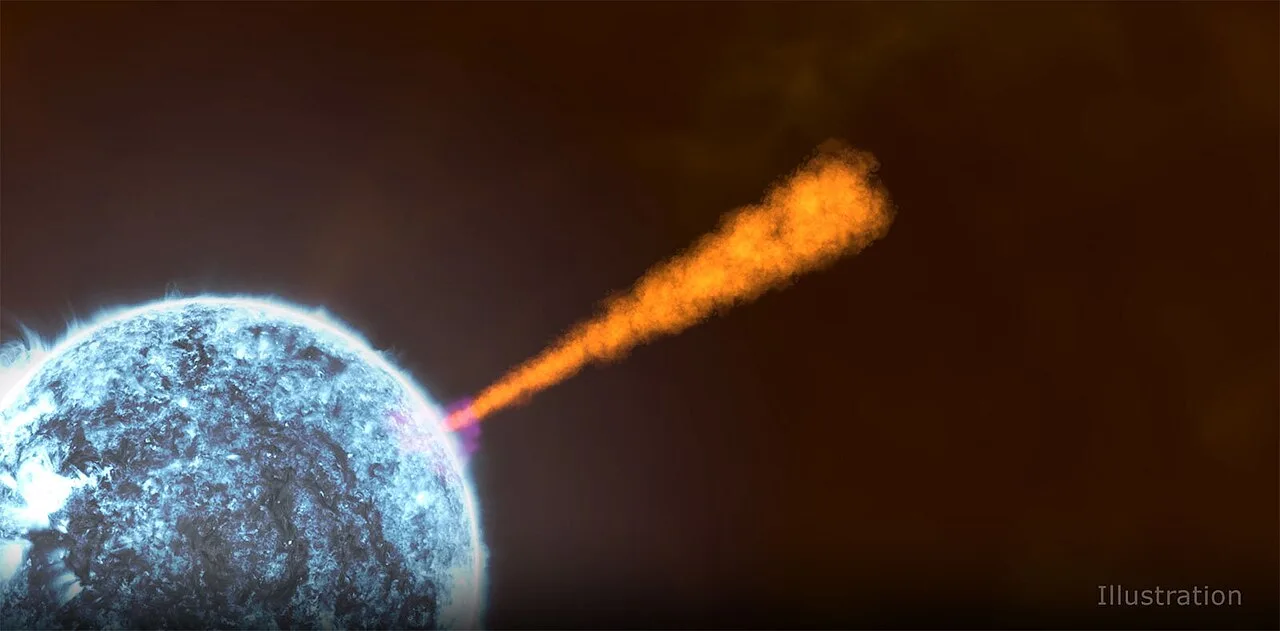
Astronomers have identified a gamma-ray burst whose power source stayed active for roughly 27 days, flaring in X-rays long after the initial blast. That is 20 days longer than the previous record for a burst of this type. The event, designated GRB 220706A, was detected on July 6, 2022, and researchers still do not know what engine drove it.
X-ray flaring after a burst is common, said study team member Benjamin Gompertz of the University of Birmingham, but it has always come within the first few days. "The fact that we see flaring at around 27 days in the GRB's rest frame tells us that there's an ongoing active process, and that's unprecedented in the known population," he told Space.com. The earlier record for delayed flaring was about six days.
A rare, ultra-long blast
Gamma-ray bursts are among the most powerful explosions in the cosmos. Long-duration ones have been linked to the collapse of a massive star, which also triggers a supernova and creates a black hole. Short-duration bursts are thought to come from the collision of two neutron stars. GRB 220706A belongs to a rarer class called ultra-long bursts, in which the engine stays active for longer and whose cause is still unknown.
A supernova accompanied this burst, which shows that a star collapsed. But that does not explain the extremely late flaring or the unusually bright supernova, Gompertz said. Another ultra-long burst, GRB 111209A in 2011, also came with an unusually bright supernova and showed clear evidence of a central engine. The team behind that work concluded a magnetar powered it, a neutron star with an especially strong magnetic field that rotates about 1,000 times per second. "Our supernova looks a lot like that one, so a magnetar might be present here," Gompertz said.
He named a second possibility: the burst jet and the supernova may be hitting shells of dense material the parent star threw off near the end of its life.
A very large star, or a different remnant
The team is not sure why this engine produced 27 days of flaring. One idea is a much bigger star than those that usually produce such bursts. Wolf-Rayet stars, about 10 times wider than the sun with around 10 times its mass, are possible sources of gamma-ray bursts, but even their collapse cannot explain this one. By the team's estimate, powering GRB 220706A would take a star about 1,000 times the radius of the sun, the kind found among blue supergiants. Or the remnant may be what differs: if the star left a magnetar, "normal" bursts may simply collapse to black holes.
Gompertz said the late flares also strain current models of how jets are powered.
Bursts this long are hard to catch because most detecting satellites sit in low Earth orbit, which blocks the target about every 90 minutes. That is fine for a typical burst lasting 10 to 100 seconds, but not for one that lasts a month. Long-lasting bursts also seem more active in X-rays than in gamma rays, so newer missions such as the Einstein Probe, which is more sensitive in X-rays, may find more of them. A pre-peer-reviewed version of the research is on the arXiv repository.
Source: Space.com