JWST Finds Reflective Clouds on Lava Planet TOI-561 b
A 37-hour Webb observation suggests the molten-rock planet has an atmosphere with silicate clouds that reflect about three-quarters of its starlight.
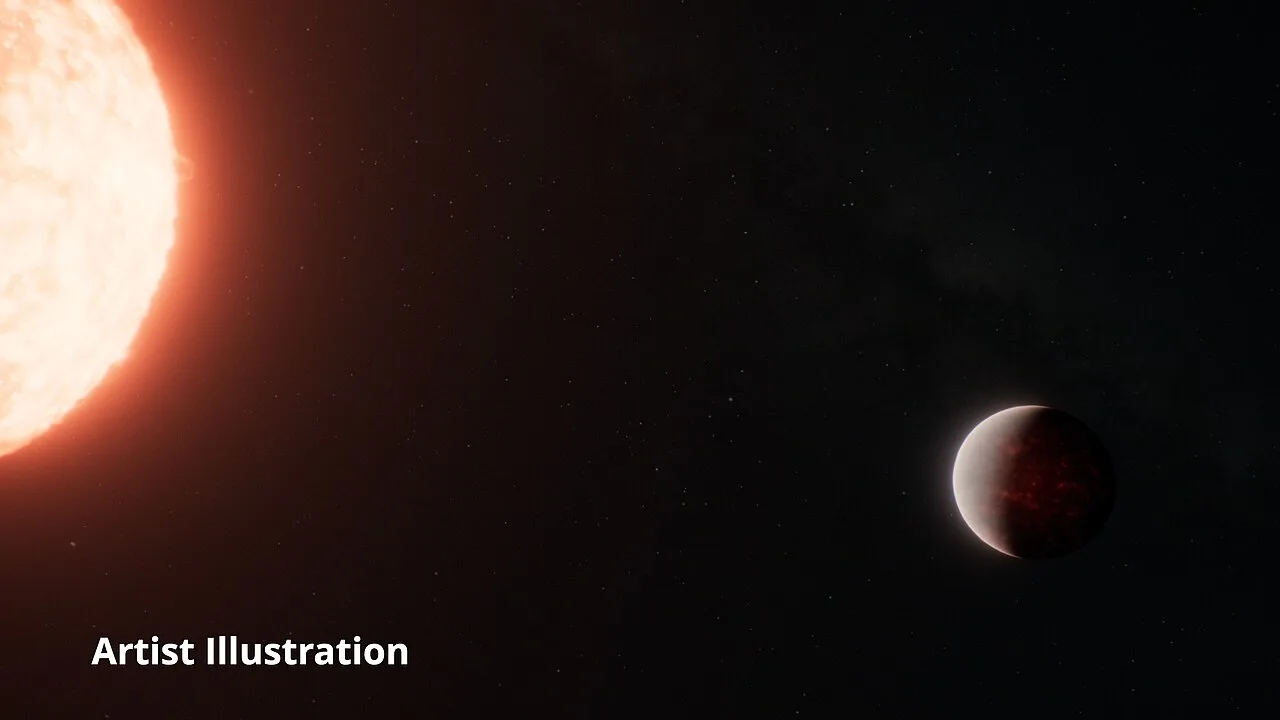
A rocky lava planet once thought too extreme to hold an atmosphere appears to be wrapped in one, topped by a reflective layer of vaporized silicate mineral clouds. The planet is TOI-561 b, and the finding comes from observations with the James Webb Space Telescope (JWST) led by University of Waterloo astronomer Lisa Dang. The clouds are made of the same family of compounds as quartz and sand.
The team watched the planet for 37 hours, covering nearly four complete trips around its star. The technique is called a phase curve. "We measured how the planet's brightness and heat changed throughout its orbit," Dang said. It showed that the planet reflects a significant amount of light from its star and that heat is being redistributed around the planet rather than staying only on the sunlit side. Together, she said, these point to an atmosphere.
Where the missing heat went
An earlier study had found the dayside far cooler than a bare, dark rock so close to its star should be. The missing heat could have been carried to the night side or reflected away before the planet absorbed it. The full-orbit observation gave the first look at the night side, which always faces away from the star. It was not warm enough to account for the difference. Instead, the planet must reflect roughly three-quarters of the starlight that strikes it, comparable to Venus.
To explain that brightness, the researchers compared the data with a computer simulation of the planet's climate. It suggests clouds of silicate minerals, including silicon dioxide (SiO2) and magnesium silicate (MgSiO3), could form on the dayside and act like sunscreen. By reflecting starlight and keeping the planet cooler, the clouds may help it hold on to an atmosphere that would otherwise be stripped away.
What the air is made of
The results build on earlier evidence from Dang and her collaborators that TOI-561 b has a thick atmosphere, likely replenished by gases released from its molten interior. An ocean of molten rock covers the surface and could act as a planet-wide volcano that keeps feeding the atmosphere.
What the atmosphere contains is still open. It could be a dense blanket of carbon dioxide, like a much hotter Venus, or rich in sulfur dioxide, a gas released from Jupiter's volcanic moon Io. "The next big question we will seek to answer is whether TOI-561 b's atmosphere resembles Venus or an extreme Io," Dang said. Observing at longer wavelengths with JWST could help explain how such a hot planet has kept an atmosphere for billions of years.
The paper's first author, Samuel Boucher, began the project as an undergraduate research intern at the Trottier Institute for Research on Exoplanets. The study was published in The Astronomical Journal.
Source: Phys.org