NASA's Swift Observatory Ends Its Science Mission
Swift made its last observation on Oct. 20 as atmospheric drag at its low orbit kept its telescopes from holding steady. It leaves an archive of about 12 terabytes.
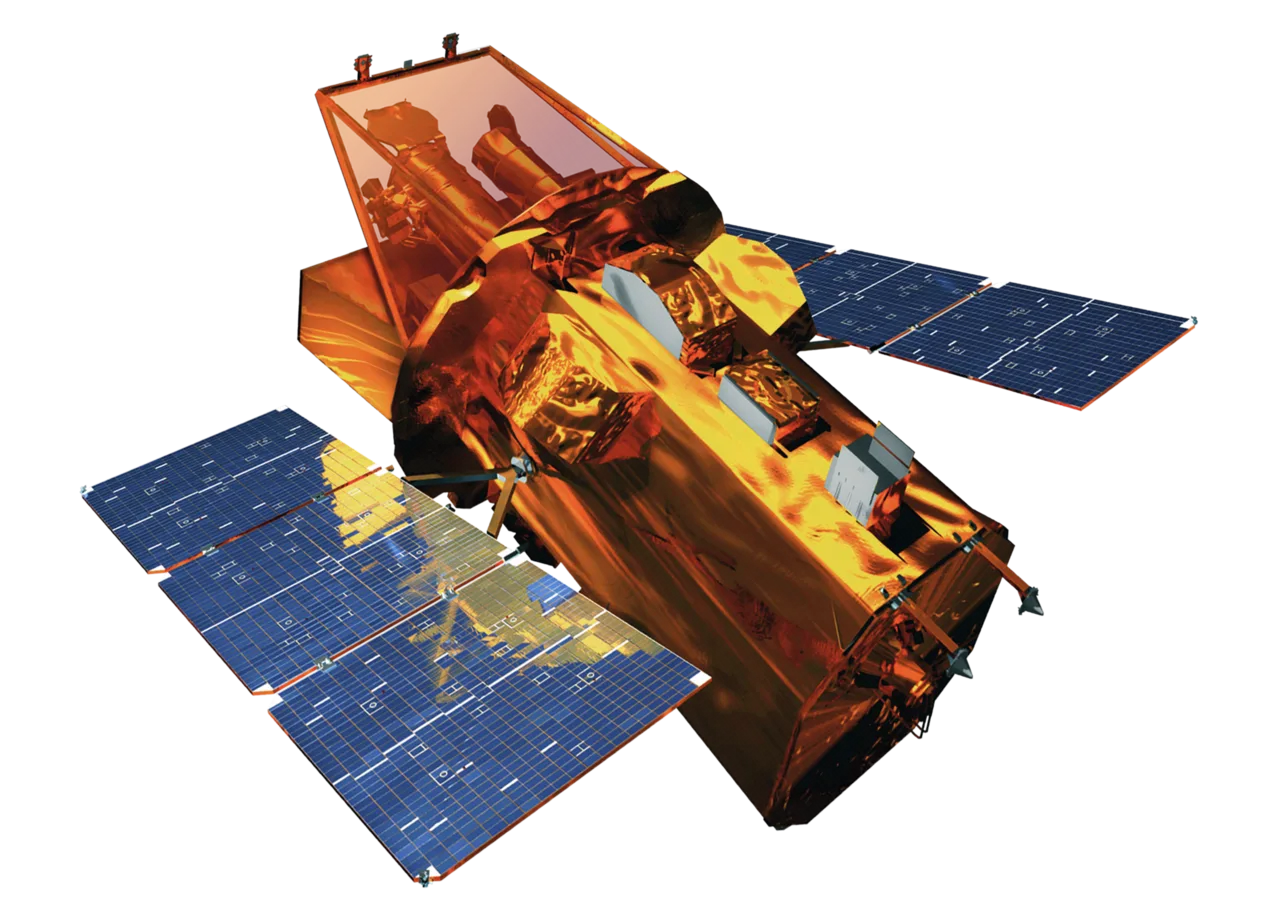
NASA's Neil Gehrels Swift Observatory has stopped its science work. The spacecraft now orbits less than 171 miles (275 kilometers) above Earth, and at that height atmospheric drag keeps its telescopes from holding steady on a target.
Swift made its final observation on Oct. 20 and is expected to re-enter the atmosphere within the next few weeks.
The observatory launched on Nov. 20, 2004, and was designed for a two-year primary mission. It ran for more than ten times that long. In 2018 NASA renamed it after Neil Gehrels, its first principal investigator, who had died.
A gamma-ray burst hunter
Swift was built to study gamma-ray bursts, flashes too brief to aim large telescopes at after the fact. It had to detect and locate a burst, send the position to other observatories and swing its own telescopes around before the afterglow faded, which typically took about a minute, said principal investigator S. Bradley Cenko of NASA's Goddard Space Flight Center.
In May 2005 it caught GRB 050509B, which lasted just 0.03 seconds, and detected 11 X-ray photons from it. That was the first short burst with a detected afterglow, and the observations supported models in which short bursts come from mergers of two neutron stars.
A flexible planning system let astronomers request target-of-opportunity observations that could be commanded from the ground within minutes. It could schedule up to 75 independent targets a day.
Over its career Swift observed more than 2,000 gamma-ray bursts and studied more than 1,400 supernovae. It also watched stars torn apart by black holes, monitored active galaxies, carried out an all-sky X-ray survey and studied asteroids and comets. Its data contributed to about 7,000 published scientific papers.
"Swift delivered an incredible, lasting return on investment for the nation," said Shawn Domagal-Goldman, director of the Astrophysics Division at NASA Headquarters.
The archive
The public archive holds nearly 22 years of brightness measurements of cosmic outbursts, multiwavelength spectra and more than 1.5 million images from the Ultraviolet/Optical Telescope. It totals about 12 terabytes, roughly the storage of 600 high-definition movies.
NASA says it will keep looking for ways to respond quickly to cosmic events, using existing missions in the meantime.
Source: NASA