Head Anything Builds 3D Head Meshes From a Few Photos
A new research system turns several images of one person into a detailed 3D head mesh for each image. Its authors report 32% lower head Chamfer distance than the best image-to-3D generator.
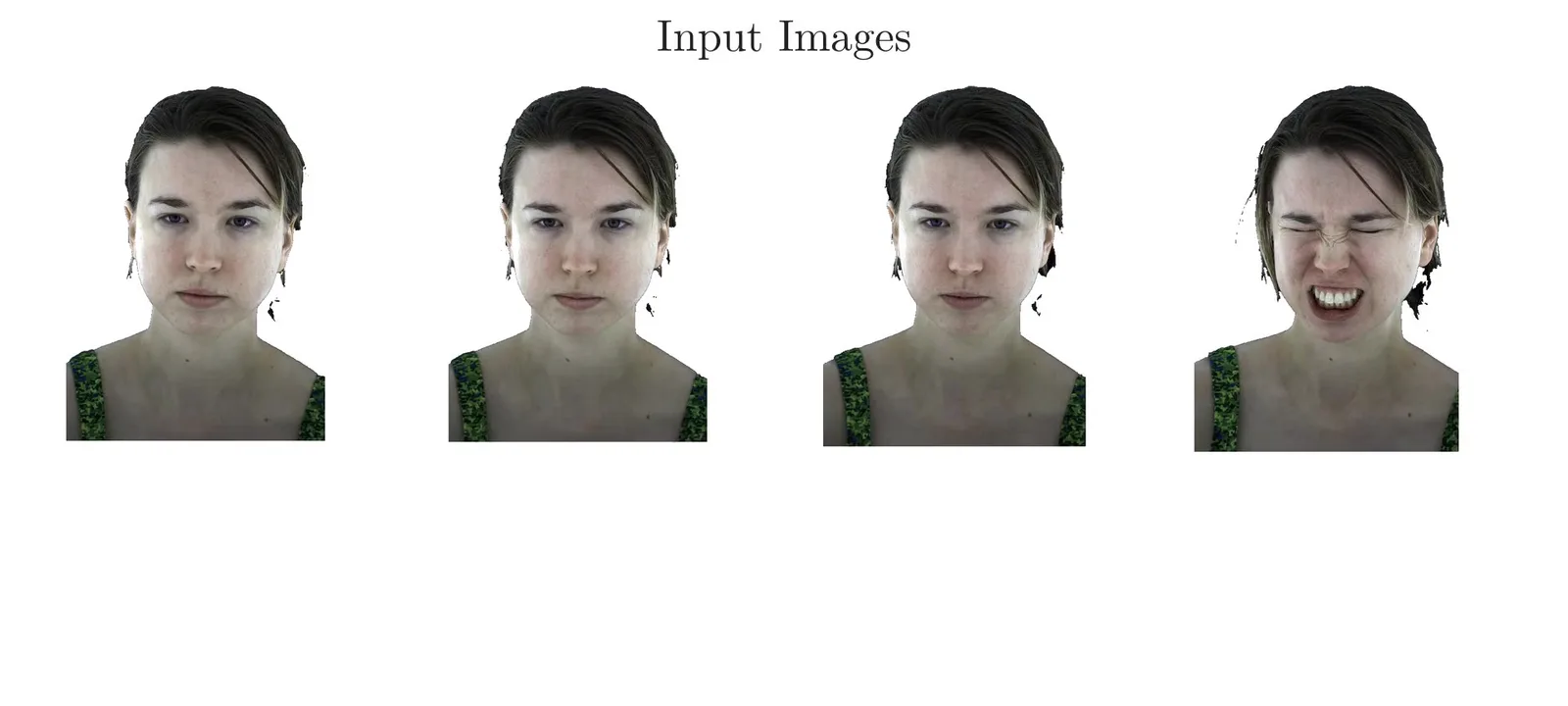
Researchers have unveiled Head Anything, a system that builds a detailed 3D head mesh from only a few photos of one person. The photos can show different expressions and viewpoints.
The problem with one photo at a time
Today's large image-to-3D generators can recover a detailed head from a single photograph. But they treat every image as a separate object. Give such a tool several pictures of the same person and each one is processed alone.
The result is that parts no image shows get invented again and again, and the inventions do not match. In the project's comparison, one such generator, Pixal3D-FT, hallucinated a different hairstyle for every frame when the back of the head was not visible in any input.
One generator, all images at once
The team did not train a new model on many images at once. They started from a pretrained generator that works on one image and has its own native 3D latent space, then reworked it to denoise all the images together.
The base is Pixal3D. The authors first fine-tuned it on photorealistic renders of head scans from the NPHM dataset. That gave it a strong prior for heads seen in one image.
Letting every image attend to every other image is hard to learn when 3D head data is scarce. The authors say they had only a few hundred scanned identities. So they added lightweight correspondence-attention adapters. Each 3D token looks only at its matching points in the other images. The adapter also holds a learned null key-value pair. With it, a token is free to disregard a match that is hidden or wrong.
The matches come from the generator itself. The system fits a neural parametric head model to the single-image meshes of all the pictures, which spares it any ground truth when it runs on new images. During training the adapters see both ground-truth and fitted matches, which makes them robust to fitting errors.
What the numbers say
Each output mesh stays pixel-aligned with its own image. It also fills in the regions hidden in its own view from what the other images show, so the meshes share one hairstyle instead of many.
On head scans, the authors report that Head Anything's meshes land 32% closer to the true scan than those of the best image-to-3D generator, measured by head Chamfer distance. Chamfer distance measures how far the generated surface lies from the true scan. Cross-frame inconsistency drops by 47%. The meshes also improve face tracking.
Accuracy rises as images are added. A target frame generated from one, two and four images of the same person becomes more accurate and complete each time.
Still unreleased
The code and models have not been published yet. The authors say only that they will be released. Until they appear, the results rest on the authors' own examples.
Source: Head Anything project page