Physicist Extends Black Saturn Solution to Two Rotation Planes
A University of Amsterdam physicist has found a way for a hypothetical five-dimensional black hole system to spin in two independent planes at once.
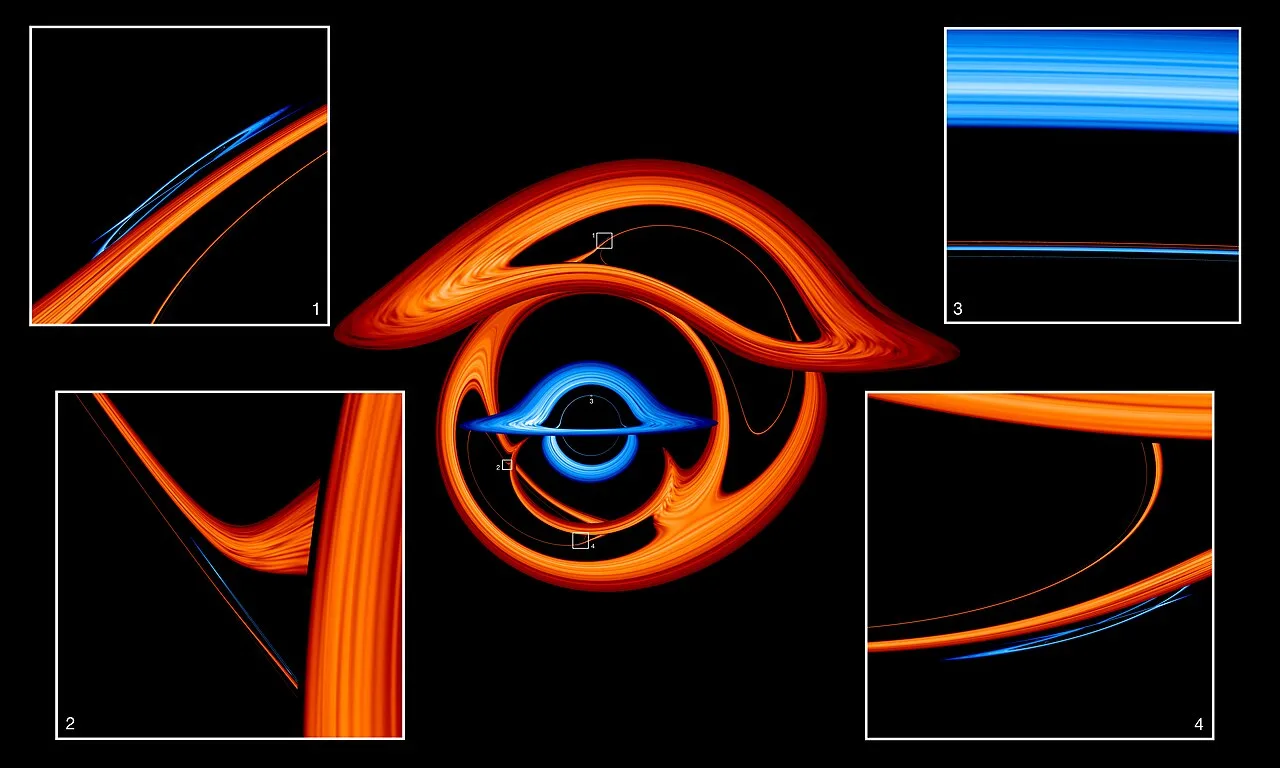
A new mathematical solution to Einstein's equations lets a strange pair of black holes spin in two independent planes at once. It is a thought experiment, but it widens what general relativity is known to allow.
The headline result: two black holes at absolute zero
The striking part of the new work concerns a limit. A black hole can carry only so much angular momentum for its mass. Reach that ceiling and it is called extremal, and its Hawking temperature falls to absolute zero. Such a black hole gives off no Hawking radiation.
In five dimensions there is a catch. A black hole must spin in both independent planes to become extremal without its event horizon vanishing altogether.
Jay Armas of the University of Amsterdam shows that both black holes in a Black Saturn can be extremal at once, each keeping its own horizon. Per the report, this is the first known exact solution of that kind in an otherwise empty five-dimensional spacetime.
Zero temperature does not mean rest. Full equilibrium would need the two rotations to match in both planes, and Armas found a regular Black Saturn cannot manage that.
What a Black Saturn is
An ordinary black hole is a ball of space that light cannot leave. In five-dimensional spacetime, with one extra spatial dimension, There a black hole's horizon can take the shape of a ring, like a donut.
A second, spherical black hole at the middle of the ring completes what theorists call a Black Saturn. Each member has its own event horizon: the boundary past which escape would demand travel faster than light.
Spin is what keeps the ring from collapsing under its own gravity. The central black hole behaves more like the four-dimensional kind.
Why a second plane of rotation matters
In our four-dimensional spacetime the rules are familiar. The extra dimension does not change general relativity itself. It simply admits shapes that four dimensions forbid, and it adds a second independent way to spin.
The first mathematical description of a Black Saturn dates from 2007. It had a limit: both black holes could rotate in only one plane. Allowing both planes brings in configurations the 2007 solution left out, and the equations grow far more tangled.
Armas published his answer as a preprint on arXiv. "The space of black holes in higher-dimensional vacuum gravity is richer than its four-dimensional counterpart," he writes.
Spinning without being spun
The two objects share one spacetime, and their gravity reaches beyond their horizons. Rotation lets them twist the space around them, which physicists call frame dragging.
A Black Saturn on paper only
Nothing suggests Black Saturns exist in nature, or that the extra dimension they require is real. The value is in the exploration. Exploring such solutions lets physicists re-test old predictions and probe gravity in settings unlike anything we can observe.
It may also help later studies of light and matter near such configurations, and of what lies inside their horizons.
Source: ScienceAlert