Euclid's First Big Data Release Reveals Over 900 Million Galaxies
ESA's Euclid mission has released its first major dataset, with 900 million galaxies and about 15,000 probable strong gravitational lenses that could help probe dark matter.
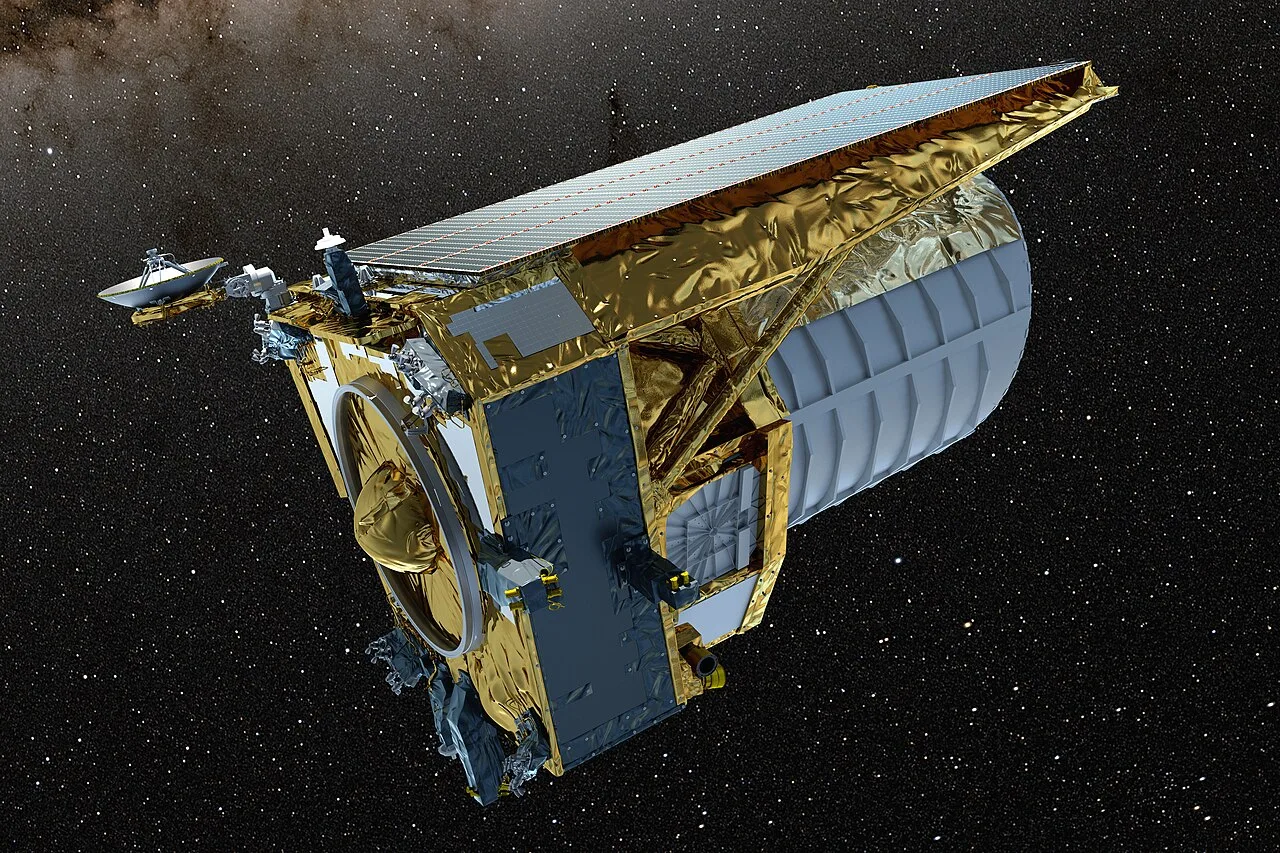
Astronomers who once had about 1,000 known strong gravitational lenses now hold roughly 15,000 probable ones, from the first major data release of the European Space Agency's Euclid mission, which also covers more than 900 million galaxies. Lenses matter because they may help reveal what dark matter is.
A jump from 1,000 to 15,000 lenses
Strong gravitational lensing was previously considered a rare phenomenon. It happens when one galaxy, often inside a cluster, sits in front of a more distant one. Einstein predicted that a massive foreground galaxy would curve space-time around it, so light from a galaxy far behind arrives as bright arcs or rings. The nearer galaxy acts a little like a magnifying glass.
Before Euclid, experts knew of about 1,000 cases. The new data holds about 15,000 probable ones, and an estimated 170,000 are expected by the end of the mission, according to Prof Andy Taylor of the University of Edinburgh. He leads the UK science ground segment for Euclid.
How a bent arc points to dark matter
Dark matter adds mass to a galaxy, and mass is what bends the light. So the effect is significantly boosted when dark matter is present. How strongly the light bends also depends on how the dark matter is spread through the galaxy, which in turn depends on its properties.
That is why Taylor thinks lenses could let researchers rule out theories of dark matter. Stephen Serjeant of the Open University agreed. Different types of matter clump in very different ways, he said, so the clumping is very diagnostic. He called strong lensing a good bet, though not a certainty, for the next breakthrough on what dark matter is.
Sharp detail over a huge area
The release covers about 14% of the total sky area Euclid will eventually map. Besides the galaxies, it records more than 60m potential quasars: blazing objects in the cores of remote galaxies, with a supermassive black hole as the engine.
Taylor said other surveys are bigger, but none has Euclid's detail and information content. Hubble produces images of incredible resolution but covers a smaller area. Euclid keeps that sharpness while mapping huge volumes of the sky, he said.
The full plan would make it the largest cosmic map ever made, covering a third of the sky and reaching back more than 10bn years. Euclid launched in July 2023. Its targets are dark energy and dark matter, thought to make up about 70% and 25% of the universe.
A second release due next summer
Another release is expected next summer. It will include results on how galaxies are distributed, and on weak gravitational lensing: subtle distortions of distant objects caused by dark matter in front of them. Taylor said the pattern of those distortions can chart where all the dark matter sits in the universe. Scientists could then calculate the statistics of that distribution and test different theories against it.
Different types of dark matter and dark energy should leave slightly different patterns on the sky.
The volume is already beyond human inspection. "No human eyeball is able to look at all of the Euclid data any more," Taylor said.
Source: the Guardian