Hera Sees Both Didymos Asteroids Separately for the First Time
ESA's planetary defense probe has told its two target asteroids apart in a single image. Closer views of Dimorphos are promised for November 25.
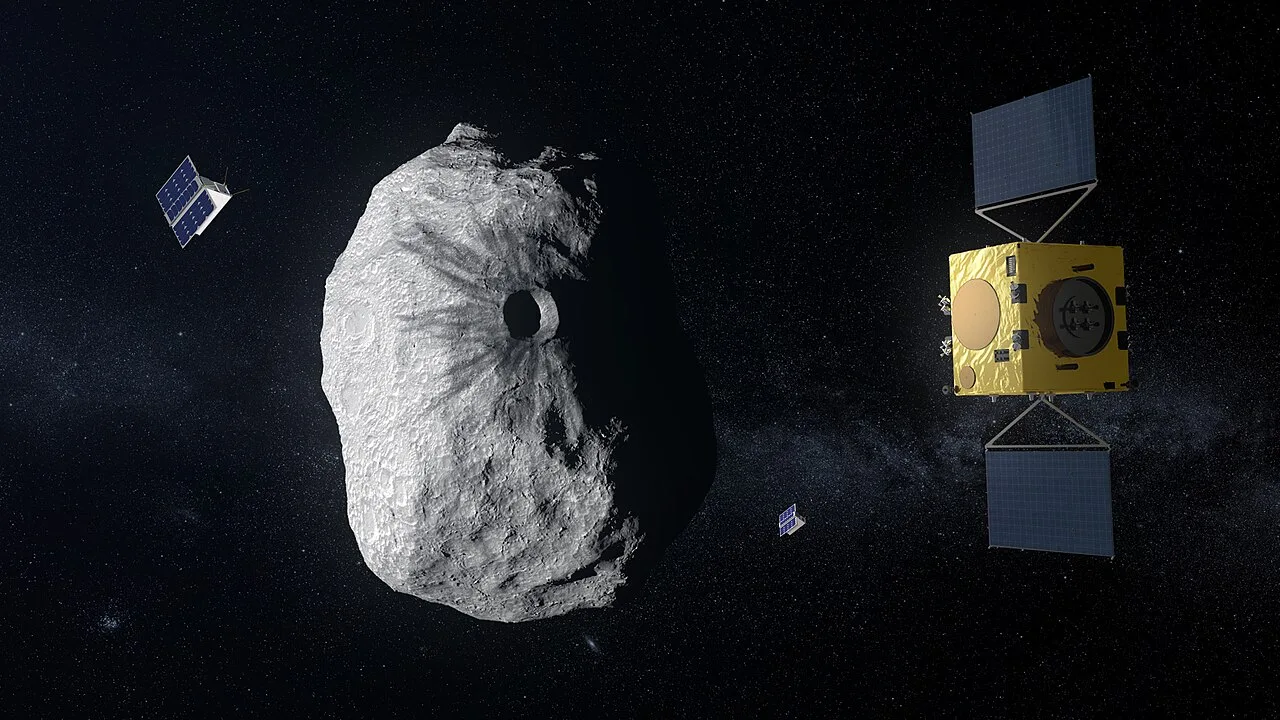
The European Space Agency's Hera spacecraft has resolved its two target asteroids as separate objects for the first time. The image shows the binary nature of the Didymos system, which is about 197 million km (122 million miles) from Earth.
Hera took the picture with its monochromatic Asteroid Framing Camera on the evening of Friday, Oct. 18. The spacecraft was 1,280 km (795 miles) from the pair.
Until then the system showed up as a single dot. In the new frame the smaller body, Dimorphos, covers only around one pixel, but it is clearly set apart from its parent.
"Before this acquisition the spacecraft was still resolving the Didymos system as a single dot," said Michael Kueppers. "But now, even though Dimorphos is made up of only around one pixel in this initial image, it is clearly well separated from its parent body."
Braking made the approach possible
The image followed two thruster firings a week apart earlier this month. They slowed Hera to just 20 m/s (45 miles per hour) relative to the asteroids, so it can close in gradually.
Dimorphos is 151 m (495 feet) across, about the size of the Great Pyramid of Giza. Didymos measures 780 m (2,560 feet), a little smaller than the Burj Khalifa. The two orbit an average 1.15 km (0.71 miles) apart, and Dimorphos moves around its parent at about 18 cm/s (7.1 inches per second).
Mission manager Ian Carnelli said the team is now seeing the double asteroid system "through Hera's own eyes". ESA plans to release the first detailed images of Dimorphos on Nov. 25.
On Sept. 26, 2022, NASA's DART spacecraft hit Dimorphos at 6.1 km/s (3.8 miles per second). The impact threw a plume of debris across 10,000 km (6,200 miles) and shortened the asteroid's orbit by around 33 minutes. Dimorphos is the first object in the solar system to have had its orbit measurably shifted by human action.
Open questions remain, including whether the impact left a crater or reshaped the asteroid, what Dimorphos is made of, and why the deflection was far greater than simulations predicted. Hera will investigate the crash site over the coming months with several instruments. It will also deploy two shoebox-sized CubeSats for a closer survey, and later move on to landing.
Source: Phys.org