Double Debris Disk Found Around Dead Star J1328−1450
Astronomers using ESO's Very Large Telescope found two separate rings of debris around a white dwarf. Two surviving planetary bodies may shape them.
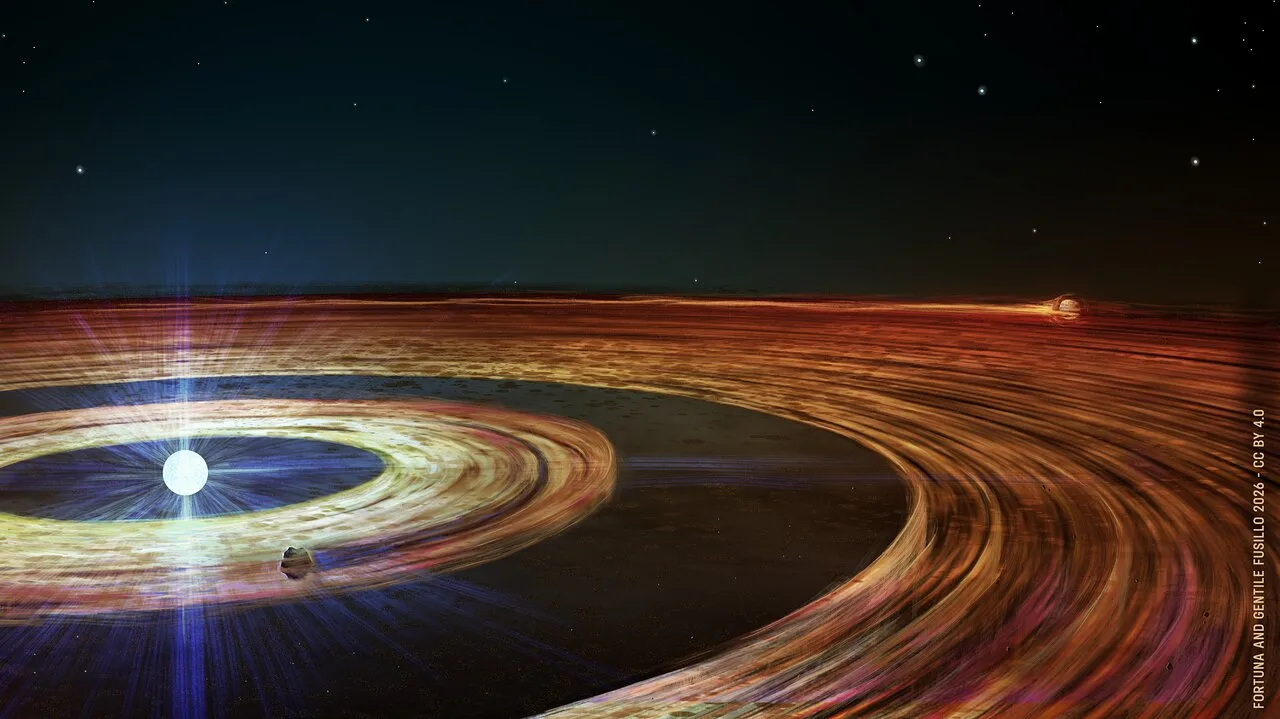
A dead star has a rare debris disk. Astronomers using the European Southern Observatory's Very Large Telescope (VLT) found that the leftovers of its planets form a double disk, with a clear gap between the two parts.
The star is the white dwarf J1328−1450, the dense, burnt-out core of a star similar to our sun that ran out of fuel. Every known debris disk around a white dwarf has shown the signature of a single, flat, rotating disk. This one breaks the pattern. Instead of one ring of vaporized planetary rubble, two concentric rings surround the star.
The team thinks two surviving planet-like bodies on separate orbits keep the structure going. The one in the inner ring is about the size of a typical asteroid, a few kilometers across. The outer one could be as large as Pluto, or even the moon.
Different chemistry in each ring
The observations were made with the X-Shooter instrument on the VLT in Chile's Atacama Desert. They show calcium, oxygen, magnesium and iron in the disk. That matches the rocky planetary material found in our own solar system.
The rings differ from each other. The inner one is rich in magnesium gas, and the outer one is largely stripped of it. The researchers say this suggests the planetesimals feeding the rings came from two planets of different compositions. Another explanation is that they are different parts of one body, such as the crust and core of a planet.
"We have known for some time that planets may survive beyond the transformation of their central star, but this is the first example of a complex system with a double debris disc and potentially two surviving planetesimals," said Nicola Gentile Fusillo of the Università degli Studi di Trieste, lead author of the study in Nature Astronomy. Co-author Felipe Lagos-Vilches of the University of Warwick said the two gaseous rings are remarkably stable and stay separated by a gap.
The sun will one day become a white dwarf too, in a process that may destroy Earth. "The system therefore offers a remarkable glimpse of what the future of planetary systems, including systems like our own, might look like," Lagos-Vilches said.
Source: European Southern Observatory