Rubin Observatory Spots Dwarf Planet Candidate 2026 ED138
A distant icy body beyond Pluto, provisionally named 2026 ED138, may become a sixth recognized dwarf planet. Rubin data led to the find.
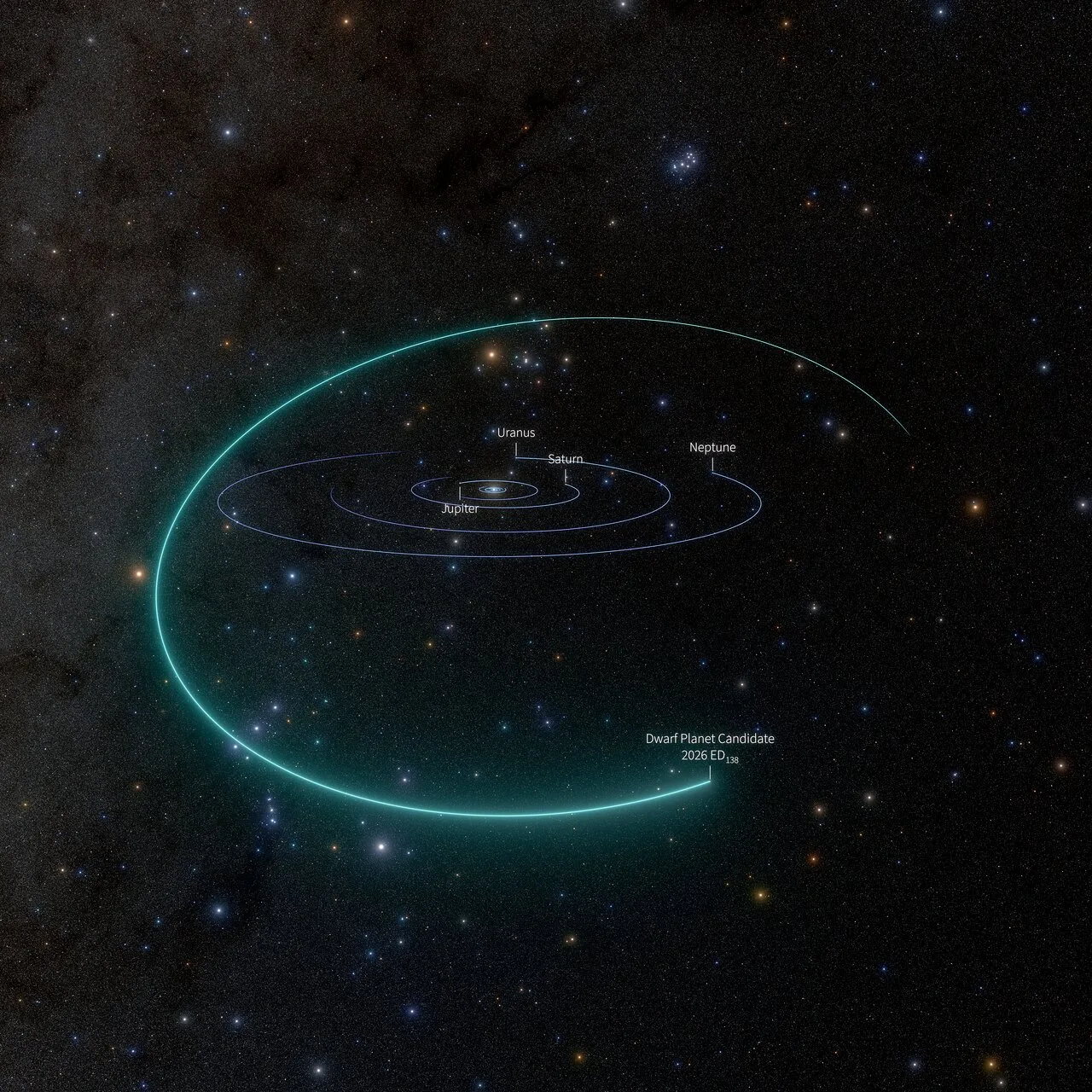
The NSF-DOE Vera C. Rubin Observatory has turned up a possible new dwarf planet. The icy body, provisionally named 2026 ED138, orbits beyond Pluto. It was spotted earlier this month by a scientist combing through data from the observatory's Simonyi Survey Telescope.
If confirmed, it would join the five dwarf planets the International Astronomical Union recognizes: Pluto, Ceres, Eris, Haumea and Makemake. Early measurements place it among the largest dwarf planet candidates ever found beyond Neptune.
Matthew Holman of the Center for Astrophysics | Harvard & Smithsonian, a member of the Rubin Operations team, and Mario Jurić, University of Washington faculty and Rubin's Solar System Lead Scientist, presented the results at a press conference. Holman made the first detection. Jurić added more observations.
A search code and a surprise
On the evening of Oct. 13, Holman ran Rubin data collected earlier in 2026 through a search code he built with colleague Kevin Napier. The code compares billions of detections of moving objects and links those that belong to the same body. It flagged ED138, and Holman noticed at once that its brightness and distance pointed to an unusually large object.
"My first reaction was one of excited disbelief," Holman said. "Objects like this are very rare, so I immediately started checking whether I or the code had done something wrong."
Jurić searched Rubin's catalogs and images and found 20 more observations, going back to March 2026. The team also found the object in archival images from other surveys dating to 2016. That gave them more than 10 years of its orbit.
Size and location
ED138 sits about 46 astronomical units from the sun. Pluto averages 40. That makes it a trans-Neptunian object. The team puts its size between 600 and 1,500 kilometers (370 to 930 miles). Bodies that large are expected to be round, but more observations are needed to measure the exact size and confirm it is a dwarf planet.
The object lies near the plane of the Milky Way, a field crowded with millions of stars. Most telescopes lose it among background sources, which is probably why it went unnoticed until now. Rubin's continuous monitoring of the Southern Hemisphere sky and its algorithms for picking out small moving points of light made the find possible.
"Rubin is giving us an unprecedented capacity to explore the sky through a combination of speed, depth, and precision," Jurić said. "Once we identify a new object, we can search back months, and sometimes even decades, finding it in images where nobody knew to look."
In all, Rubin's Simonyi Survey Telescope observed ED138 30 times on 20 nights between March 4 and July 11. The object's orbit is tilted almost 25 degrees off the plane of the Solar System. That makes it a hot-classical trans-Neptunian object, which suggests Neptune's gravity disturbed it from its original orbit.
The Legacy Survey of Space and Time began in June 2026. In April, before it formally started, the Rubin team announced observations of more than 11,000 new asteroids, including roughly 380 new trans-Neptunian objects. Holman said the survey will image the whole southern sky again and again for 10 years, so any others hiding in places earlier surveys skipped are now within reach.
Source: Vera C. Rubin Observatory