Webb Spots Early Galaxy That May Leak Most of Its Ionizing Light
Astronomers studying galaxy EBG-1, seen 530 million years after the Big Bang, say its spectrum fits an ionizing-photon escape fraction of about 85%.
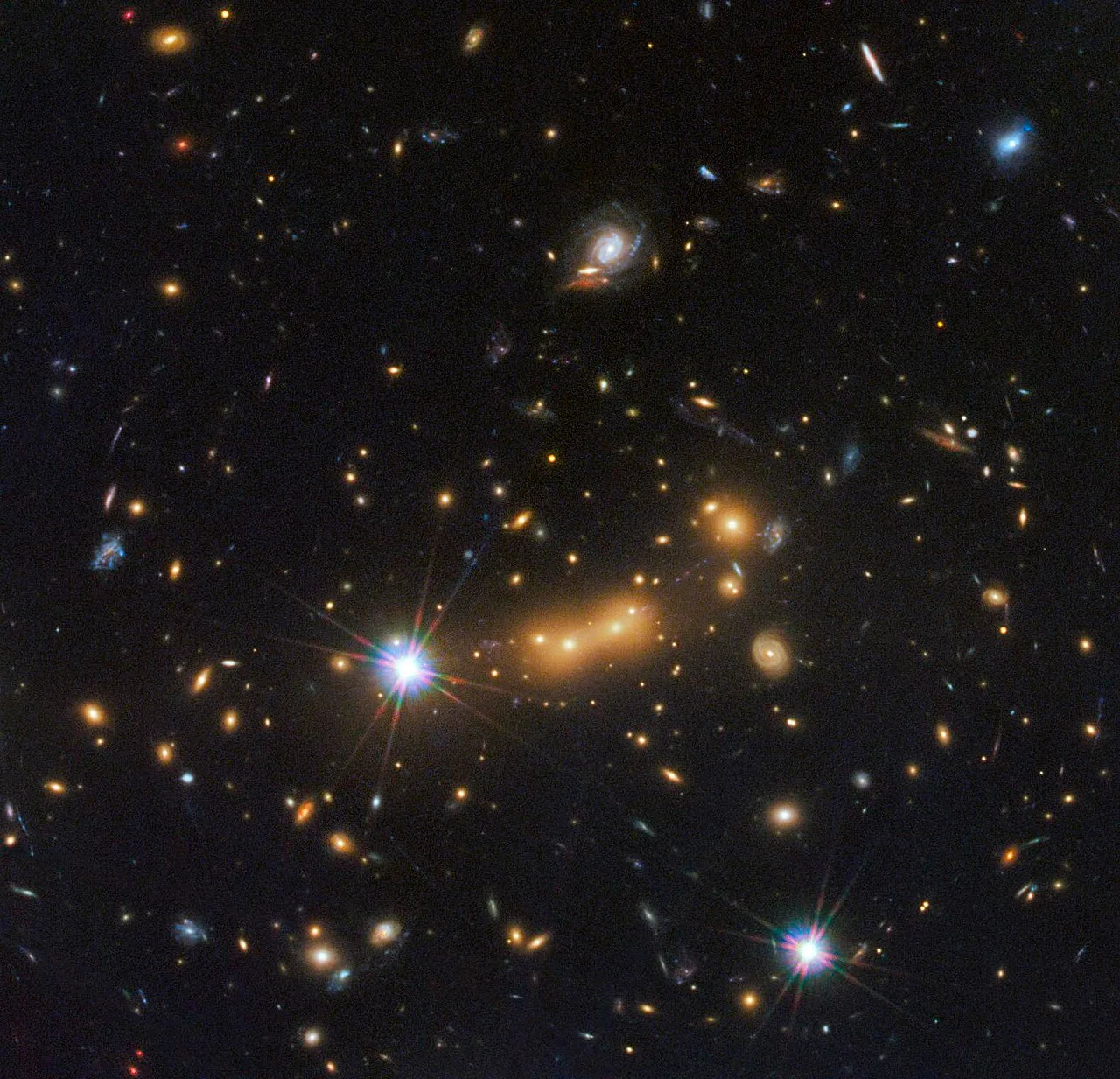
A team using the James Webb Space Telescope has found evidence that a very distant galaxy lets most of its ionizing radiation escape into space. The galaxy, called EBG-1 (Extreme Blue Galaxy 1), is seen at a redshift of 9.244, about 530 million years after the Big Bang. The paper was posted to the arXiv preprint server on Oct. 16.
The researchers were led by Yunjing Wu of the University of Tokyo. EBG-1 is gravitationally lensed by a foreground galaxy cluster, MACS0647. The cluster's gravity bends and magnifies the galaxy's light, so astronomers can see it in detail.
Why escape matters
Cosmic reionization is thought to have happened roughly between 600 million and a billion years after the Big Bang, and to have been complete by redshift 5.5. Ionizing ultraviolet radiation from early stars and galaxies turned neutral hydrogen gas into the ionized state seen today. That light is mostly made of Lyman continuum photons, with wavelengths below 912 Å.
Gas and dust inside a galaxy absorb much of it. The share that escapes is called the escape fraction, and it is key to estimating a galaxy's contribution. "Which galaxies supplied most of the ionizing photons remains debated," the researchers write. Some models favour dwarf galaxies, others more massive galaxies with efficient star formation.
What the spectrum showed
EBG-1 has one of the bluest ultraviolet slopes yet measured at this redshift. A very blue slope can suggest little dust, very young stars and a metal-poor composition. It can also hint that ionizing photons are escaping.
To test this, the team took a deep 14-hour observation with the NIRSpec instrument and looked for lines from carbon, hydrogen and oxygen. Emission lines were weak overall. The oxygen line was prominent, the hydrogen line was weak and carbon was not detected at all.
The paper, titled "Can Blue UV-Bright Galaxies Drive Reionization at Cosmic Dawn?", gives EBG-1 an absolute UV magnitude of −19.6 and an escape fraction of about 0.85.
From the oxygen-to-hydrogen ratio, the team estimates the galaxy's oxygen abundance at only about 3% of the sun's. That is consistent with a young galaxy, since stars make heavy elements over time.
Comparing the data with synthetic spectra, the team found that models with an escape fraction of around 85% fit best. Those models assumed constant star formation and no dust. "EBG-1 shows spectroscopic signatures of a high escape fraction," the researchers conclude.
If that reading is right, EBG-1 could be a highly efficient leaky source that helped reionize the early universe. It is a single object, though, and its environment has not been studied, so astronomers do not know its local contribution. The authors write that a census of neighbouring galaxies would show whether the local ionizing budget is dominated by EBG-1 or by its surroundings.
Source: Phys.org